Showing posts with label USS Hornet. Show all posts

Saturday, November 5, 2022

November 5, 1942 - Thursday - 80 years ago today

Status - John Skinner: 

By this time, the crew of O'Brien are nearing the US west coast, on schedule to arrive some time around November 7th.

Transports arrived at Guadalcanal bringing needed artillery to the Marines, primarily 155 mm howitzers that allow attacks on Japanese positions in the western part of the island.  Navy cruisers and destroyers also shell this area.  The Japanese navy is still able to land more troops and supplies.

U. S. Navy Task Forces:

  • Task Force 16 (Enterprise) was still at Noumea for temporary repairs to Enterprise.
  • Saratoga remained at Pearl Harbor for repairs (sailed November 10th).
  • Combined Task Force 61 was at Noumea.
    • Task Force 16 (Enterprise) -> TF 61  

More Information:

  • Official Navy Chronology, pp. 271-273.
  •  The First Team and the Guadalcanal Campaign,  John B. Lundstrom, pp 460-466.
  • The Struggle for Guadalcanal, Samuel Eliot Morison, pp. 224-226.
  • Neptune's Inferno, The U.S. Navy at Guadalcanal, James D. Hornfischer, pp. 237-245.


NEXT POST: NOVEMBER 9TH

Monday, October 24, 2022

October 24, 1942 - Saturday - 80 years ago today

 Status - John Skinner: 

The crew of O'Brien was rescued on the 19th as the ship sank, and became passengers on the two other accompanying ships.  These ships did not take them all the way to the west coast; they would have to find transportation on other ships bound for San Francisco.  We could speculate that they were delivered to nearby Pago Pago to await transportation.  It appears they reached the United States on or around November 7th.

Admiral Ghormley had been replaced as area commander by the much more aggressive Admiral Halsey.  As the Marines on Guadalcanal fought off attacks from the Japanese troops on the 23rd and 24th, Halsey began to plan for new Navy action in the upcoming days.

U. S. Navy Task Forces:

  • Task Force 16 (Enterprise) sailed from Pearl Harbor on October 16th for the South Pacific, crossing the equator on the 19th.
  • Saratoga remained at Pearl Harbor for repairs (sailed November 10th).
  • Combined Task Force 61 remained on patrol in the Coral Sea near Guadalcanal.
    • Task Force 17 (Hornet) -> TF 61 

More Information:

  • Official Navy Chronology, pp. 266-267.
  •  The First Team and the Guadalcanal Campaign,  John B. Lundstrom, pp 334-343.
  • The Struggle for Guadalcanal, Samuel Eliot Morison, pp. 181-193.
  • Neptune's Inferno, The U.S. Navy at Guadalcanal, James D. Hornfischer, pp. 214-222.


NEXT POST: OCTOBER 28TH

Sunday, October 16, 2022

October 16, 1942 - Friday - 80 years ago today

Status - John Skinner - USS O'Brien: 

O'Brien, with its escorts Cimmaron and Lang, reached Suva, Fiji on the 13th, and had only a broken plate as damage since being repaired at Noumea.  After repairs the ships left on the 16th toward American Samoa and then on to the West Coast.  There were two October 16ths, as the date line was crossed at midnight on the 16th and date was backed up a day.  Water leakage was increasing on O'Brien but was not yet considered serious.  War Damage Report #28 narration:

Task Group 66.3 arrived at Suva on 13 October. While there, damage and previous repairs to O'BRIEN were thoroughly inspected. Except for the broken plate on No. 6 port longitudinal no other evidence of failure or weakness in the repairs previously made was discovered. The broken plate was repaired by welding an angle to it, apparently along the top.

Departure from Suva was made about 1430 on 16 October. Shortly after departure and when in the open sea, rate of leakage again increased but not alarmingly so as one fire and bilge pump was more than adequate to control the leakage. Wind and sea were still very moderate.

At 0000, zone minus 12, October 17, the date was changed due to crossing the international date line and the 16th was repeated.

 Bombardment of Guadalcanal

The Marines were heavily bombarded for three consecutive nights, the first night Japanese battleships fired 14 inch shells into the airfield and surroundings.  Japanese heavy cruisers did more damage the second night.  The US Navy was unable to counter these attacks, and the Marines have not forgotten even to this day.  Most of the planes at the field were damaged or destroyed and the Japanese also landed several thousand more troops on the island.  This appeared to be another big Japanese offensive to push the Marines off the island.

U. S. Navy Task Forces:

  • Task Force 16 (Enterprise) sailed from Pearl Harbor on October 16th for the South Pacific.
  • Saratoga remained at Pearl Harbor for repairs (sailed November 10th).
  • Combined Task Force 61 remained on patrol in the Coral Sea near Guadalcanal.
    • Task Force 17 (Hornet) -> TF 61 

More Information:


NEXT POST: OCTOBER 20TH


Wednesday, October 12, 2022

October 12, 1942 - Monday - 80 years ago today

Status - John Skinner - USS O'Brien: 

O'Brien's repairs were completed on October 10th.  Unnecessary weight was removed from the ship.  O'Brien and its two escorts left Noumea on the 10th headed for Mare Island in the San Francisco bay area.

"In addition to structural repairs, O'BRIEN was further lightened while at WHITE POPPY by removing 11 torpedoes, 12,000 rounds of 20mm ammunition, eight 300-lb. depth charges, all SC radar equipment and the computer.

"Upon completion of repairs at WHITE POPPY, O'BRIEN was considered capable of making 15 knots in a moderate sea. Mare Island was accordingly designated as the repair yard. At 0800 on 10 October O'BRIEN departed WHITE POPPY in company with CIMARRON and LANG. The group was designated as Task Group 66.3 with the Commanding Officer of CIMARRON as Commander of the Task Group."

-- War Damage Report #28. 

The sailors onboard were not so confident that these orders were a good idea.  As John told me later, anyone could see there was no way that was going to hold up long enough to get back.  These sentiments were no doubt expressed in saltier language when the orders came to make for the West Coast.  The Navy, however, thought all had been done that could be done, and they would just have to chance it; in the forward areas there were no dry docks or sophisticated repair facilities.

Pearl Harbor was closer than the West Coast, but with two carriers in for repairs, it may not have been able to accommodate more ships.   

Cimarron, an oiler headed back to the West Coast for refurbishment, and Lang, a destroyer were the escorts for O'Brien.  The first destination was Suva, Fiji.  

"Upon completion of repairs at WHITE POPPY, O'BRIEN was considered capable of making 15 knots in a moderate sea. Mare Island was accordingly designated as the repair yard. At 0800 on 10 October O'BRIEN departed WHITE POPPY in company with CIMARRON and LANG. The group was designated as Task Group 66.3 with the Commanding Officer of CIMARRON as Commander of the Task Group.

"After getting underway, a slow increase in the rate of leakage into the forward engine room was observed. This was not considered abnormal because of the many small patches and loose rivets in the underwater body. The Commanding Officer reported that a thorough check of the deflection across the damaged area showed that bending there was almost exactly the same as that across a similar undamaged length in the after engine room. Just how these observations were made was not reported, but ordinarily the problem of obtaining reliable hull deflection readings at sea is a difficult one. On the morning of the 13th of October, just prior to arrival at Suva, the reinforcing plate on No. 6 port deep longitudinal was found cracked, indicating a tensile failure. This 860 mile passage was made with turns for 13 knots attaining a speed over the ground of 12 knots. Wind and sea did not exceed moderate intensity."

-- War Damage Report #28.

 Some defects were showing up as noted, but Suva was reached on the 13th. Here is a map of the area, Noumea on the left, Fiji on the right.  Espiritu Santo (modern day Vanuatu), where the initial repairs were made, appears at the top left.:


Battle of Cape Esperance

On the night of October 11-12, a Navy cruiser force caught by surprise a Japanese cruiser force sent toward Guadalcanal to escort troop transports and shell the Marine positions.  Unlike earlier night actions, the US cruisers and destroyer found success, as a Japanese heavy cruiser and a destroyer were sunk, with a loss of one US destroyer.  This bolstered the confidence of the sailors, and was publicized at home as a victory, but did little to change the overall situation.

The Japanese transports delivered their troops and equipment to Guadalcanal, as the Japanese army forces there planned another assault on the Marines.


U. S. Navy Task Forces:

  • Task Force 16 (Enterprise) was at Pearl Harbor, for repairs to Enterprise (sailed October 16th).
  • Saratoga was at Pearl Harbor for repairs (sailed November 10th).
  • Combined Task Force 61 remained on patrol in the Coral Sea near Guadalcanal.
    • Task Force 17 (Hornet) -> TF 61 

More Information:


NEXT POST: OCTOBER 16TH


Saturday, October 8, 2022

October 8, 1942 - Thursday - 80 years ago today

Status - John Skinner - USS O'Brien: 

O'Brien remained at Noumea (code name WHITE POPPY) alongside repair ship Argonne for further and more permanent repairs.  Repairs would be finished October 10th.

Hornet conducted a raid on Japanese forces in the Shortland Islands, which are further up the Solomons chain near Bougainville.  The raid was hampered by inclement weather, and so achieves little.

Japanese Navy plans include a cruiser force coming down the slot to shell Guadalcanal while other ships unloaded supplies.  US cruiser forces, now better trained and equipped, would soon have to detect and counter this force.

U. S. Navy Task Forces:

  • Task Force 16 (Enterprise) was at Pearl Harbor, for repairs to Enterprise (sailed October 16th).
  • Saratoga was at Pearl Harbor for repairs (sailed November 10th).
  • Combined Task Force 61 remained on patrol in the Coral Sea near Guadalcanal.
    • Task Force 17 (Hornet) -> TF 61 

More Information:


NEXT POST: OCTOBER 12TH


Tuesday, October 4, 2022

October 4, 1942 - Sunday - 80 years ago today

Status - John Skinner - USS O'Brien: 

O'Brien remained at Noumea (code name WHITE POPPY) alongside repair ship Argonne for further and more permanent repairs.  Repairs would be finished October 10th.

Here are some more details on the repairs, from the Navy report:

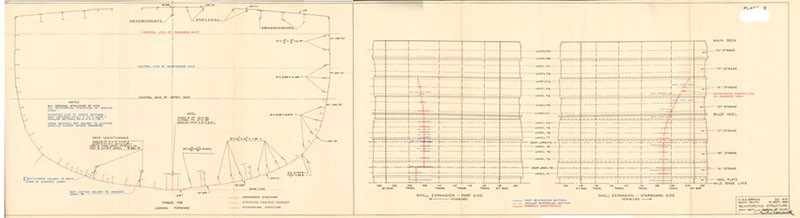
Details of hull repairs to the bottom structure, frames 103-109, in the forward engine room are shown on plate II. Attention is invited to the following features:

(a) Only partial longitudinals were installed. That is, fore-and-aft extent was only three frame spaces for all temporary members. Installation was made by welding longitudinals to the shell. Somewhat less than half of the replacement sections had the ends welded to adjacent web frames.

(b) Scantlings used were either about the same or larger than those of the longitudinals which each temporary member was to reinforce. There was no allowance, however, in the scantlings to replace the strength of the ship girder lost by the wrinkled bottom shell plating, including the flat keel.

(c) The partial longitudinals installed were offset transversely from the longitudinals they were obviously intended to reinforce. 


 Plate II

 Plate II: Reinforcing Structure.


 ----------------------------

Admiral Nimitz visited the area during this time, starting on September 28th landing at Noumea.  A meeting was held on Argonne to discuss current activities and future strategy.  Admiral Ghormley, who was in charge of the theater, was showing deeply the stresses of command.  Noumea itself was choked with cargo ships unable to unload at the relatively small port.  Nimitz went to Guadalcanal after the meeting, and then back to Hawaii.  

Hornet and escorts had moved northwest for a raid on Japanese forces in the Shortland Islands, near Bougainville Island.  These forces were a constant danger to Henderson Field and the Marines on Guadalcanal.

U. S. Navy Task Forces:

  • Task Force 16 (Enterprise) was at Pearl Harbor, for repairs to Enterprise (sailed October 16th).
  • Saratoga was at Pearl Harbor for repairs (sailed November 10th).
  • Combined Task Force 61 remained on patrol in the Coral Sea near Guadalcanal.
    • Task Force 17 (Hornet) -> TF 61 

More Information:


NEXT POST: OCTOBER 8TH


Friday, September 30, 2022

September 30, 1942 - Wednesday - 80 years ago today

Status - John Skinner - USS O'Brien: 

O'Brien remained at Noumea (code name WHITE POPPY) alongside repair ship Argonne for further and more permanent repairs.  Repairs would be finished October 10th.

There continued a tense calm around Guadalcanal.  Hornet was able to make a short visit to Noumea to resupply and refuel.

U. S. Navy Task Forces:

  • Task Force 16 (Enterprise) was at Pearl Harbor, for repairs to Enterprise (sailed October 16th).
  • Saratoga was at Pearl Harbor for repairs (sailed November 10th).
  • Combined Task Force 61 remained on patrol in the Coral Sea near Guadalcanal.
    • Task Force 17 (Hornet) -> TF 61 

More Information:


NEXT POST: OCTOBER 4TH


Tuesday, September 27, 2022

September 26, 1942 - Saturday - 80 years ago today

Status - John Skinner - USS O'Brien: 

O'Brien arrived at Noumea (code name WHITE POPPY) on the 23rd, and went alongside repair ship Argonne for further and more permanent repairs.  All work on O'Brien would be done on October 10th.  Below is described the transit to Noumea and some of the modifications done to the ship:

Upon departure from BUTTON, course was laid for WHITE POPPY, 600 miles distant, and O'BRIEN arrived on 23 September. Engine speed during the passage was for 12.5 knots but speed over the ground was only 11.5 knots. Again wind and sea never exceeded moderate intensity. O'BRIEN remained at WHITE POPPY until 10 October. During this period further repairs were accomplished by ARGONNE and ship's force.
 
During the two passages described above, O'BRIEN rode easily. Working of the forward and aft portions of the vessel with respect to each other was not observed although careful inspections and observations were frequently made. Repairs to the bottom at BUTTON by CURTISS were very effective in reducing leakage in the forward engine room. Only one fire and bilge pump was required to control leakage from BUTTON to WHITE POPPY whereas the main circulator, operating at near capacity, was required to control leakage prior to arrival at BUTTON.
 
At WHITE POPPY, ARGONNE executed further temporary structural repairs. At the stem a partial new bow section, extending down from the forecastle deck to half way to the waterline, was installed to protect against the force of seas when pitching.

U. S. Navy Task Forces:

  • Task Force 16 (Enterprise) was at Pearl Harbor, for repairs to Enterprise (sailed October 16th).
  • Saratoga was at Pearl Harbor for repairs (sailed November 10th).
  • Combined Task Force 61 remained on patrol in the Coral Sea near Guadalcanal.
    • Task Force 17 (Hornet) -> TF 61

 As only Hornet was currently available, it would fall to the cruisers and destroyers to protect the Marines on Guadalcanal to try to block Japanese forces coming down the Slot to bombard the Marines and/or to deliver troops and supplies.  Given the bad performance in the early night battles, especially Savo Island, intense drills and practice for night battles was done all through late September.

More Information:

  • Official Navy Chronology, pp. 254-256.
  •  The First Team and the Guadalcanal Campaign,  John B. Lundstrom, pp 233-243.
  • The Struggle for Guadalcanal, Samuel Eliot Morison, pp. 138-139.
  • Neptune's Inferno, The U.S. Navy at Guadalcanal, James D. Hornfischer, pp. 132-144.


NEXT POST: SEPTEMBER 30TH


Thursday, September 22, 2022

September 22, 1942 - Tuesday - 80 years ago today

Status - John Skinner - USS O'Brien: 

O'Brien had arrived on the 16th at Espiritu Santo (code name BUTTON) and remained until the 21st. Curtiss would do the temporary repairs.  Below are excerpts from War Damage Report No. 28 regarding the damage and repairs:

Photos 2 and 3 portray the small amount of local structural damage at the bow. Center of impact appears to have been just abaft the forefoot and possibly 10 feet below the waterline. The draft forward prior to damage was 11'-7". As shown on plate I, the bow structure below the main deck and aft to frame 10 was blown away. Framing and plating back to frame 14 were twisted and distorted. Free flooding occurred below the first platform between frames 10 and 22. Draft forward increased to 12'-2". A-202-L, on the first platform, flooded slowly to a depth of about two feet, the water entering through ruptures in the deck and bulkhead 14 as the bow plunged into the seas. Bulkhead 22 remained tight but was bulged aft. Bulkhead 25 was undamaged.

Photos 2 and 3:  Structural Damage at the Bow.  Quite a bit of the bow was shot away. but as noted above, the structure is holding.


Severe vertical flexural vibration of the hull occurred. Although some buckling of hull plating and longitudinals occurred in the vicinity of frames 37, 78 and 123, some of which is shown in photos 4 and 5, the most serious failures were centralized across the bottom structure in the vicinity of frame 104. Here, as will be noted on plate II, the vertical keel, No. 2 deep longitudinals, No. 6 deep longitudinals, several smaller longitudinals and bottom plating all failed to some degree. The Commanding Officer reported that wrinkling and buckling of the shell and longitudinals, including the vertical keel, extended from frame 104 on the starboard side across to frame 108 port. The entire bottom flange of the ship girder was thus seriously damaged. In addition, many rivets in this area were loosened or sheared. Considerable leakage into the forward engine room resulted through seams and rivet holes. The Commanding Officer reported that planes of the roller paths of the after 5" guns were depressed about one degree to port indicating that the after portion of the hull was twisted slightly to port.

Photos 4 and 5:  Topside damage accompanying damage to the bottom structure amidships.


Other damage is also described in the War Damage Report.  Below excerpt describes the temporary repairs done at Espiritu Santo:

O'BRIEN remained at BUTTON until 21 September. During this period O'BRIEN, CURTISS and the Seventh Naval Construction Battalion effected temporary repairs. Bulkhead 6 above the main deck, the main deck, the deck of A-202-L and bulkhead 14 between the first platform and main deck were all made tight by patching holes. Bulkheads 6 and 14 were reinforced with concrete. The deck of A-202-L and bulkhead 14 were also strongly shored. In addition, divers installed plug bolts and patches in the bottom plating of the forward engine room. All except two 600-pound depth charges were removed as were 150 rounds of 5" A.A. common. Finally, anchors and anchor chains were removed from the bow and stowed aft.

O'Brien left Espiritu Santo on the 21st en route to Noumea (code name WHITE POPPY), which is about 460 miles SSE from Espiritu Santo.


U. S. Navy Task Forces:

  • Task Force 16 (Enterprise) was at Pearl Harbor, for repairs to Enterprise.
  • Saratoga was at Pearl Harbor for repairs.
  • Combined Task Force 61 remained on patrol in the Coral Sea near Guadalcanal.
    • Task Force 17 (Hornet) -> TF 61

More Information:

  • Official Navy Chronology, pp. 253-254.
  •  The First Team and the Guadalcanal Campaign,  John B. Lundstrom, pp 229-232.
  • The Struggle for Guadalcanal, Samuel Eliot Morison, pp. 130-138.
  • Neptune's Inferno, The U.S. Navy at Guadalcanal, James D. Hornfischer, pp. 118-131.


NEXT POST: SEPTEMBER 26TH


Sunday, September 18, 2022

September 18, 1942 - Friday - 80 years ago today

Status - John Skinner - USS O'Brien: 

Hornet and Wasp were now protecting the convoy that was to bring the new Marine regiment to Guadalcanal.  The two carriers were separated by about 5 miles, and were in the Coral Sea, about 150 miles southeast of San Cristobal Island, which was at the southeast end of the Solomons chain.  They were maintaining a position between Japanese forces and the convoy, and had planes in the air constantly.  Wasp had the day's duty for the combat air and anti-submarine patrols.

Several spots in the oceans had been nicknamed "Torpedo Junction" (no doubt sardonically named after the Glenn Miller Orchestra's Tuxedo Junction, a #1 hit song in 1940).  The two carriers were right in the middle of one of these.  Japanese submarines were always present here, and with the convoy in the area, were even more alert.  

Wasp was maneuvering to recover planes, and inadvertently lined itself up for a shot from Japanese submarine I-19.  The Japanese sub took full advantage, firing a spread of 6 torpedoes at the carrier.  Three impacted Wasp and started a series of huge explosion on the carrier.  Sailors on  the O'Brien would have seen the explosions immediately, but would have already begun to change their ship's course in reaction before they heard the report of the blasts some half a minute later.

The three torpedoes that missed Wasp continued on with their remaining fuel.  One of these was dodged by destroyer Mustin but scored a direct hit on battleship North Carolina.  The other two were heading straight for the USS O'Brien.

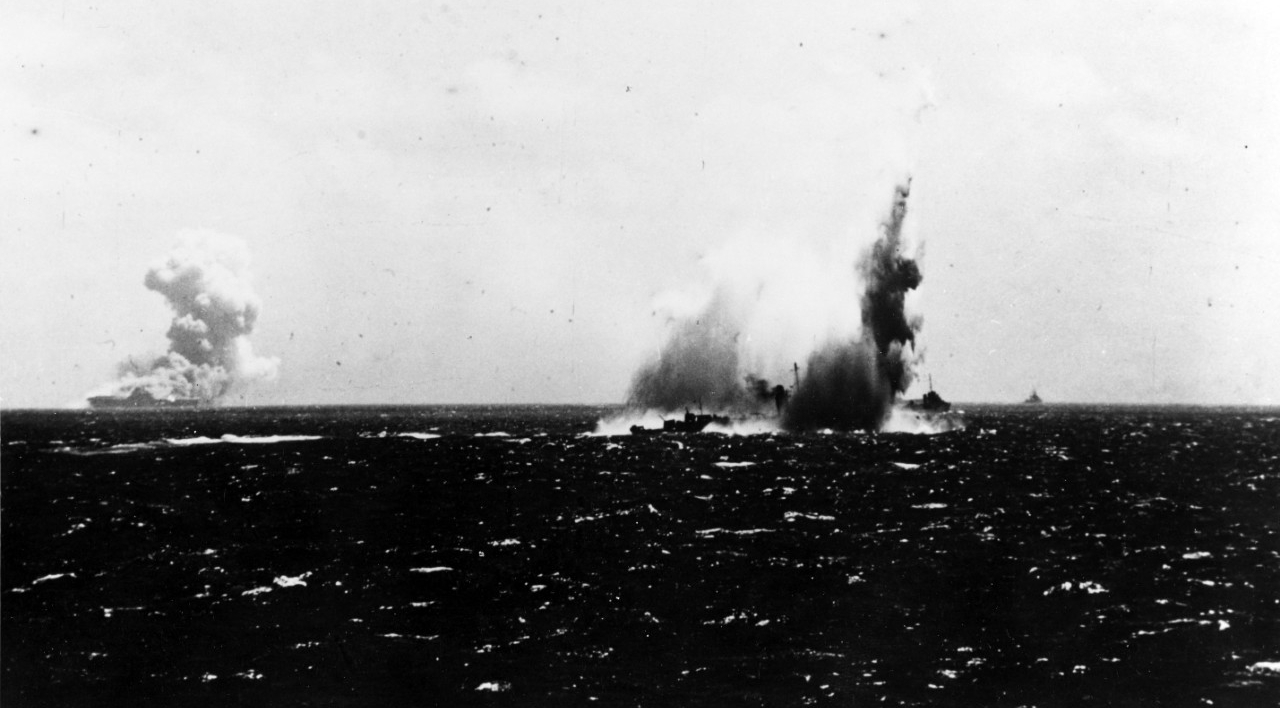
 O'Brien's crew had seen the first torpedo, and had swerved to starboard, successfully avoiding the it as it passed a small distance from the stern.  The second torpedo, however, had gone unnoticed; by the time it was seen it was to late to avoid, and crashed into O'Brien's bow.  The moment of impact was captured in one of the more famous photos of World War 2 (below):

Wasp burns in the background as torpedo strikes O'Brien:

Photo #: 80-G-457818  USS O'Brien (DD-415)


The torpedo had severely damaged the bow on the O'Brien and shaken the ship violently, but there were no casualties.  Even with the damage, the ship could still make 15 knots, and was ordered to head unescorted to Espiritu Santo (BUTTON) for repairs, reaching there on the 16th.  O'Brien went alongside repair ship USS Curtis.

Wasp continued to burn and could not be salvaged.  It was sunk with torpedoes from destroyer Lansdowne. Hornet took on Wasp's planes that were still airborne, and was now the only US carrier in the South Pacific.  The Wasp's sinking was held secret until December; only then could sailors on leave talk about the loss of Wasp.

North Carolina returned to Pearl Harbor for repairs.  Fast Battleship strength was down from three to one as a result (South Dakota having earlier scraped a reef and retired to Pearl Harbor).

This single spread of torpedoes was the most devastating of the war; it had initially been credited to two Japanese submarines, but in reality came only from I-19.

The convoy carrying the Marines, despite losing much of its air cover, did land on Guadalcanal on the 18th, bringing much needed relief to the garrison there.

In 2019 a search was conducted for the sunken Wasp - Article:

U. S. Navy Task Forces:

  • Task Force 16 (Enterprise) was at Pearl Harbor, for repairs to Enterprise.
  • Saratoga was also returning to Pearl Harbor for repairs.  Arrives Sep. 21.
  • Combined Task Force 61 remained on patrol in the Coral Sea near Guadalcanal.
    • Task Force 17 (Hornet) -> TF 61
    • Wasp was sunk by Japanese submarine I-19 on September 15th.

More Information:

  • Official Navy Chronology, pp. 252-253.
  •  The First Team and the Guadalcanal Campaign,  John B. Lundstrom, pp 221-229.
  • The Struggle for Guadalcanal, Samuel Eliot Morison, pp. 130-138.
  • Neptune's Inferno, The U.S. Navy at Guadalcanal, James D. Hornfischer, pp. 118-131.


NEXT POST: SEPTEMBER 22ND

Wednesday, September 14, 2022

September 14, 1942 - Monday - 80 years ago today

Status - John Skinner - USS O'Brien:  

Hornet and Wasp continued to patrol in the Coral Sea. 

Battle of Edson's Ridge

Japanese forces on Guadalcanal were ready for a new attack on the US Marine positions  The Marines, under Colonel Merritt Edson, had dug in on a ridge about a mile south of the airfield, and other Marines defended points near the shore.  Not all of the perimeter was defended when the battle began.  After two nights of intense fighting, with the result being in doubt several times, the Marines held, losing around 100 men versus 800 Japanese.

The current Marine garrison on Guadalcanal was exhausted after several weeks of patrolling, fending off attacks, (including many night attacks) and keeping the airplanes and runway going.  Reinforcements were on the way; a new Marine regiment was coming in from Noumea.  The transports coming in would require air cover  from Task Force 61.

U. S. Navy Task Forces:

  • Task Force 16 (Enterprise) was at Pearl Harbor, for repairs to Enterprise.
  • Saratoga was also returning to Pearl Harbor for repairs.  Arrives Sep. 21.
  • Combined Task Force 61 remained on patrol in the Coral Sea near Guadalcanal.
    • Task Force 17 (Hornet) -> TF 61
    • Task Force 18 (Wasp) -> TF 61

More Information:

  • Official Navy Chronology, pp. 250-252.
  •  The First Team and the Guadalcanal Campaign,  John B. Lundstrom, pp 183-219.
  • The Struggle for Guadalcanal, Samuel Eliot Morison, pp. 123-132.
  • Neptune's Inferno, The U.S. Navy at Guadalcanal, James D. Hornfischer, pp. 118-131.


NEXT POST: SEPTEMBER 18TH


Saturday, September 10, 2022

September 10, 1942 - Thursday - 80 years ago today

Status - John Skinner - USS O'Brien:  

Hornet and Wasp continued to patrol in the Coral Sea. 

Operation Watchtower 

Admiral Ghormley, in charge in the South Pacific, was suffering from battle fatigue and there was a consideration of making a change.  Nimitz would visit Ghormley in person.  Admiral Halsey was returning from the illness that had kept him out of the Battle of Midway, and would command the Enterprise when it was repaired and sent back to the battle area.  In the meantime, fear of losing another carrier kept Hornet and Wasp south of the Solomon Islands, but within striking distance.

U. S. Navy Task Forces:

  • Task Force 16 (Enterprise) was returning to Pearl Harbor, for repairs to Enterprise. Arrives Sep. 10.
  • Saratoga was also returning to Pearl Harbor for repairs.  Arrives Sep. 21.
  • Combined Task Force 61 remained on patrol in the Coral Sea near Guadalcanal.
    • Task Force 17 (Hornet) -> TF 61
    • Task Force 18 (Wasp) -> TF 61

More Information:

  • Official Navy Chronology, pp. 249-250.
  •  The First Team and the Guadalcanal Campaign,  John B. Lundstrom, pp 164-182.
  • The Struggle for Guadalcanal, Samuel Eliot Morison, pp. 104-125.
  • Neptune's Inferno, The U.S. Navy at Guadalcanal, James D. Hornfischer, pp. 118-131.


NEXT POST: SEPTEMBER 14TH


Tuesday, September 6, 2022

September 6, 1942 - Sunday - 80 years ago today

Status - John Skinner - USS O'Brien:  

Hornet and Wasp continued to patrol in the Coral Sea.  Hornet narrowly escaped a torpedo hit when an escorting destroyer dropped a depth charge that detonated two of the torpedoes bound for Hornet.

Operation Watchtower 

Admiral Leigh Noyes had taken command of Task Force 61, flying his flag on Wasp. He created the surface task force from the ships remaining from Task Force 11, which became Task Force 64.  

Airplanes and  Marines were continually being added to the force at Guadalcanal.  This was critical as the Japanese navy was successfully landing troops, about 5,000 more during this time, on Guadalcanal also.  The island was consistently pulling in more forces on both sides and was becoming the main flash point of the Pacific war.

The thinning US carrier forces would not grow any time soon.  However, surface firepower was coming.  The new fast battleships South Dakota and Washington, were moving to the South Pacific, along with some cruisers that were specifically designed to provide potent anti-aircraft fire for task forces.  South Dakota, unfortunately, just after arriving, struck a reef and was badly damaged, and returned to Pearl Harbor for two weeks of repairs (it was also becoming an unlucky ship, like Saratoga).

U. S. Navy Task Forces:

  • Task Force 16 (Enterprise) was returning to Pearl Harbor, for repairs to Enterprise. Arrives Sep. 10.
  • Saratoga was also returning to Pearl Harbor for repairs.  Arrives Sep. 21.
  • Combined Task Force 61 remained on patrol in the Coral Sea near Guadalcanal.
    • Task Force 17 (Hornet) -> TF 61
    • Task Force 18 (Wasp) -> TF 61

More Information:

  • Official Navy Chronology, pp. 248-249.
  •  The First Team and the Guadalcanal Campaign,  John B. Lundstrom, pp 164-177.
  • The Struggle for Guadalcanal, Samuel Eliot Morison, pp. 104-122.
  • Neptune's Inferno, The U.S. Navy at Guadalcanal, James D. Hornfischer, pp. 118-128.


NEXT POST: SEPTEMBER 10TH


Friday, September 2, 2022

September 2, 1942 - Wednesday - 80 years ago today

Status - John Skinner - USS O'Brien:  

Task Force 17 merged into Task Force 61 on August 29th. At that point, Task Force 61 had three carriers again.

Operation Watchtower

On the 30th, just after Task Force 17 had merged into the Task Force 61 carrier force, a torpedo attack damaged the Saratoga.  Saratoga was drifting, and then under tow, before regaining power several hours later.  Saratoga, only recently back in service after repairs for a previous torpedoing, was ordered to Pearl Harbor, and continued to grow a reputation as an unlucky ship.

Admiral Fletcher went to Pearl Harbor also, and then was called to Washington; Admiral King was not approving of his actions in the various Pacific battles so far.  Fletcher was reassigned and eventually commanded in the North Pacific and Alaska, but never did command a carrier force again, despite his battle experience, mostly due to King's opposition.

Saratoga's planes were divided between Wasp, the newly named Cactus Air Force on Guadalcanal, and other land bases.  (The Navy had taken to code-naming its bases after flowering plants, and Cactus seems appropriate for the rough and tumble existence at Henderson Field).

Task Force 61 continued to patrol in the Coral Sea.  The remainder of Task Force 11 (Saratoga's remaining escorts) were formed into a new surface task force, to confront Japanese surface ships, especially the destroyers delivering men and supplies to Guadalcanal.

U. S. Navy Task Forces:

  • Task Force 16 (Enterprise) was returning to Pearl Harbor to repair battle damage to Enterprise.
  • Task Force 11 was disbanded.  Saratoga returned to Pearl Harbor for repairs.
  • Combined Task Force 61 remained on patrol in the Coral Sea near Guadalcanal.
    • Task Force 17 (Hornet) -> TF 61
    • Task Force 18 (Wasp) -> TF 61

More Information:

  • Official Navy Chronology, pp. 246-248.
  •  The First Team and the Guadalcanal Campaign,  John B. Lundstrom, pp 164-177.
  • The Struggle for Guadalcanal, Samuel Eliot Morison, pp. 104-117.
  • Neptune's Inferno, The U.S. Navy at Guadalcanal, James D. Hornfischer, pp. 118-126.


NEXT POST: SEPTEMBER 6TH


Monday, August 29, 2022

August 29, 1942 - Saturday - 80 years ago today

Status - John Skinner - USS O'Brien:  

Task Force 17 merged into Task Force 61 on August 29th.   

Operation Watchtower

The Japanese continued landing troops on Guadalcanal; they had begun to use destroyers, which were faster than transports, and continued despite the loss of one destroyer and damage to two others.  The Japanese command had abandoned for the present any attempt to take Port Moresby on New Guinea, and concentrated on Guadalcanal, continuously building the force there for new attacks.

The American carriers stood off somewhat from Guadalcanal due to fear of attacks from submarines and land based aircraft, but still patrolled the Coral Sea and awaited the next attack from the Japanese fleet.  The addition of the Hornet restored the Task Force to 3 carriers.

Destroyer Operations:

As the Task Force has now reached the battle area, there is obviously a heightened alert on all the ships, including O'Brien. To give some idea what it was like, here is an excerpt from the book Condition Red: Destroyer Actions in the South Pacific, by Frederick Jackson Bell.  This describes the routine on the USS Grayson prior to the Battle of the Eastern Solomons.  It would be very similar on the O'Brien once in Task Force 61:

"Several times each day the Enterprise launched and recovered planes, keeping a patrol around the formation, searching far out toward our van or flanks, then, when they came home, giving exercise to the Task Force in repelling air attacks.  Heading as we were for the back door of the Solomons, it would be another week before we would expect to sight enemy aircraft, but not for a moment could we drop our guard for it was by no means improbable that the Japs were trying the same stunt as we, but in reverse.  Certainly we could expect subs to be across our track.  There were no idle hands, and few idle moments, as we continued on our way.

"The crew stood a watch in three; four hours on watch, eight hours off, an arrangement that while apparently giving them only eight hours on watch out of every twenty-four is by no means so simple.  A man going off watch at midnight will be free until eight in the morning - except that he must go to his battle station when we go to General Quarters before dawn and remain there for an hour, until after sunrise, which allows him time for a bath and shave before breakfast at seven, and a few moments for a smoke before it is again time to go on watch.  Men on the mid-watch (midnight to four a. m.) get no sleep the remainder of the night.  During the forenoon they try to crowd in a little rest, but always there are drills, practice firings, or unexpected calls to G. Q. that keep them from their bunks.  They welcome the watch ending at eight in the evening, for with any luck they can be turned in by eight-thirty, and sleep until half-past three, when again it is 'Rouse the watch.  On deck the --- section', in the rolling, sleep-penetrating tones possessed by all good boatswain's mates.  There is time for a cup of coffee and a cigarette -- a face wash if they are inclined -- and up to their battle station fifteen minutes before the hour.  It is particularly hard on the engineers, especially in the tropics.  Our engineers didn't know it at the time -- no more did I -- but we were to steam for four months before we could secure the plant and let the fires die out under the boilers.  The future held many surprises of which we were happily unaware.

"Watches for the  officers are equally restrictive, except for the Captain and the Executive.  They have no regular watches, but the Executive Officer, in his capacity of navigator, has little chance for rest, and the Captain is fortunate if he has more than an hour's uninterrupted sleep at any time or if he can spend as many as five hours in his bunk in any twenty-four."

-- Frederick Jackson Bell, Condition Red: Destroyer Actions in the South Pacific, pp. 19-20. 


U. S. Navy Task Forces:

  • Task Force 16 (Enterprise) was returning to Pearl Harbor to repair battle damage to Enterprise.
  • Combined Task Force 61 remained on patrol in the Coral Sea near Guadalcanal.
    • Task Force 17 (Hornet) -> TF 61
    • Task Force 11 (Saratoga) -> TF 61
    • Task Force 18 (Wasp) -> TF 61

More Information:

  • Official Navy Chronology, pp. 245-247.
  •  The First Team and the Guadalcanal Campaign,  John B. Lundstrom, pp 164-171.
  • The Struggle for Guadalcanal, Samuel Eliot Morison, pp. 104-110.
  • Neptune's Inferno, The U.S. Navy at Guadalcanal, James D. Hornfischer, pp. 118-121
  • Condition Red: Destroyer Actions in the South Pacific, Frederick Jackson Bell,   pp. 19-20.  .


NEXT POST: SEPTEMBER 2ND

Thursday, August 25, 2022

August 25, 1942 - Tuesday - 80 years ago today

Status - John Skinner - USS O'Brien: 

 Task Force 17 was still proceeding south to join Task Force 61.  It was nearing the Solomons on the 25th, and was ordered to refuel and prepare for action.  Here is the description from the Hornet's history:

Once TF-17 crossed the equator, Commander South Pacific Force (ComSoPac) (Vice Adm. Robert L. Ghormley) ordered it to proceed to an area west of Guadalcanal and prepare for “offensive operations further to [the] westward.” Guadalupe fueled the task force on 25 August 1942, completing the replenishment by moonlight at 2200, then, with Hughes as escort, was detached.

Operation Watchtower - Battle of the Eastern Solomons .

The Japanese now sent a new invasion force that was accompanied by a naval task force with two fleet carriers and a smaller carrier, and a heavy force of battleships and cruisers.  The US navy had two fleet carriers; Wasp had been sent south to refuel, and Hornet (Task Force 17) had not yet arrived in the South Pacific.

The ensuing carrier battle became known as the Battle of the Eastern Solomons.  The Enterprise was heavily damaged, and was forced to return to Pearl Harbor.  The Japanese lost the light carrier Ryujo, and one of the larger carriers was damaged.  More importantly, their invasion force had to retreat and did not reach Guadalcanal.

U. S. Navy Task Forces:

  • Task Force 17 (Hornet) was in transit the South Pacific but did not arrive in time for the battle.  It would replace the damaged Enterprise (Task Force 16) on arrival.
  • Combined Task Force 61 fought the Battle of the Eastern Solomons and was able to repel the Japanese invasion force moving toward Guadalcanal.
    • Task Force 16 (Enterprise) returned to Pearl Harbor to repair battle damage to Enterprise.
    • Task Force 11 (Saratoga) -> TF 61
    • Task Force 18 (Wasp) -> TF 61

More Information:

  • Official Navy Chronology, pp. 243-245.
  •  The First Team and the Guadalcanal Campaign,  John B. Lundstrom, pp 97-164.
  • The Struggle for Guadalcanal, Samuel Eliot Morison, pp. 70-104.
  • Neptune's Inferno, The U.S. Navy at Guadalcanal, James D. Hornfischer, pp. 114-118.


NEXT POST: AUGUST 29TH


Sunday, August 21, 2022

August 21, 1942 - Friday - 80 years ago today

Status - John Skinner - USS O'Brien: 

 Task Force 17 was still proceeding south to join Task Force 61.  It had not yet reached the equator.

Operation Watchtower  .

Japanese destroyer transports made good on landing Colonel Ishiki with about 1000 of his troops on Guadalcanal.  They bypassed the Marine position at Lunga Point and were able to land east of there on the north side of the island.  The Marines soon detected the force; they ambushed a Japanese patrol, gained valuable intelligence, and awaited Ishiki's attack.  The Japanese thought there was only a small US presence, but were overwhelmed when they attacked near the Tenaru River, because the Marines had over 10,000 troops on the island.  Ishiki's force was wiped out, and he took his own life at the end of the battle.  The Japanese were undeterred; they immediately made plans to send a new force, accompanied by a large naval force of carriers and battleships.

The Marines also were supplied with fighters and bombers on August 20th.  Planes arriving were welcomed, but generally had short lifetimes due to the constant warfare on and over the island.  Resupply of aircraft was needed often.

U. S. Navy Task Forces:

  • Task Force 17 (Hornet) was in transit the South Pacific..
  • Combined Task Force 61 was patrolling in the Coral Sea.  The damage to the carriers was being assessed in preparation for returning one or more of them to Hawaii or the west coast for repairs.  Hornet would join soon as a replacement for carriers returned for repair.
    • Task Force 16 (Enterprise) -> TF 61
    • Task Force 11 (Saratoga) -> TF 61
    • Task Force 18 (Wasp) -> TF 61

More Information:

  • Official Navy Chronology, pp. 241-242.
  •  The First Team and the Guadalcanal Campaign,  John B. Lundstrom, pp 89-97.
  • The Struggle for Guadalcanal, Samuel Eliot Morison, pp. 1-69.
  • Neptune's Inferno, The U.S. Navy at Guadalcanal, James D. Hornfischer, pp. 44-113.


NEXT POST: AUGUST 25TH


Thursday, August 18, 2022

August 17, 1942 - Monday - 80 years ago today

Status - John Skinner - USS O'Brien: 

O'Brien had joined Task Force 17 at  Pearl Harbor. On August 17th, Task Force 17, centered around USS Hornet, left Pearl Harbor for the South Pacific.  Here is a description from the Dictionary of Naval Fighting Ships:

Hornet, loaded, fueled, and provisioned, cleared Pearl Harbor at 1024 on 17 August 1942 as flagship for TF-17, and wearing the flag of Rear Adm. George D. Murray, who had previously commanded Enterprise. The other ships bound for the South Pacific included Hornet’s old consort Northampton, Pensacola, San Diego, the destroyers Morris (DD-417), Mustin (DD-413) O’Brien (DD-415), Hughes (DD-410), and Russell (DD-414) and the oiler Guadalupe (AO-32). Hornet maintained inner air patrols as well as “A.M. and P.M. searches,” weather permitting. As needed, the heavy cruisers operated their float planes to spell the carrier pilots on inner air patrols.

Operation Watchtower  .

A tense quiet had settled over the south Pacific for the moment.  Plans were in motion to get an air contingent to Henderson Field on Guadalcanal.  On the Japanese side, transports would soon move toward Guadalcanal to deliver several hundred troops under Colonel Ichiki, who, confident of victory, prepared an immediate attack.

U. S. Navy Task Forces:

  • Task Force 17 (Hornet) left Pearl Harbor on the 17th for the South Pacific..
  • Combined Task Force 61 was patrolling in the Coral Sea..
    • Task Force 16 (Enterprise) -> TF 61
    • Task Force 11 (Saratoga) -> TF 61
    • Task Force 18 (Wasp) -> TF 61

More Information:

  • Official Navy Chronology, pp. 241-242.
  •  The First Team and the Guadalcanal Campaign,  John B. Lundstrom, pp 89-97.
  • The Struggle for Guadalcanal, Samuel Eliot Morison, pp. 1-69.
  • Neptune's Inferno, The U.S. Navy at Guadalcanal, James D. Hornfischer, pp. 44-108.


NEXT POST: AUGUST 17TH

Saturday, August 13, 2022

August 13, 1942 - Thursday - 80 years ago today

 Status - John Skinner - USS O'Brien: 

O'Brien had joined Task Force 17 at  Pearl Harbor. Admiral Nimitz ordered Task Force 17 to prepare to depart for the South Pacific on August 17th.

Operation Watchtower  .

The marines had established themselves on Guadalcanal and Tulagi, but still needed to fully unload troops and provisions for maintaining their positions on the islands.  However, Admiral Fletcher moved to withdraw the three carriers, and their air cover, even earlier than the proposed time that had caused so much controversy in the pre-invasion meetings.  This left the landing beaches uncovered as troops and supplies came onboard.  Fletcher, however, was determined to preserve the carriers, as the 4 current active carriers would be all the Navy would have for at least the next year.

Battle of Savo Island

Savo Island is a nearly-round, small island that is north of the western side of Guadalcanal.  This gives two natural approaches toward Guadalcanal from the west, one north of Savo island and one south.  Two US Navy cruiser forces were patrolling on the north and south sides of the island on the evening of August 9th. 

The Japanese had thought the US carriers were still in the area and not withdrawing, and so determined to send a cruiser force at night to bombard the landing zones.  This force was not detected by the US cruiser force in time; being taken by surprise, the Allied cruisers suffered heavy losses.  Four heavy cruisers, 3 US and one Australian, were sunk, another cruiser was damaged, and a destroyer was also lost,  

The Navy now had little to cover the Marines in the Solomons.  Transports would continue to bring supplies but this would be dangerous work for now.

U. S. Navy Task Forces:

  • Task Force 17 (Hornet) was at Pearl Harbor.  Extensive training was being done during this time.
  • Combined Task Force 61 supported the invasion of the Solomon Islands beginning on August 7th.
    • Task Force 16 (Enterprise) -> TF 61
    • Task Force 11 (Saratoga) -> TF 61
    • Task Force 18 (Wasp) -> TF 61

More Information:

  • Official Navy Chronology, pp. 239-241.
  •  The First Team and the Guadalcanal Campaign,  John B. Lundstrom, pp 30-33.
  • Coral Sea, Midway and Submarine Actions, Samuel Eliot Morison, pp. 280-282.
  • Neptune's Inferno, The U.S. Navy at Guadalcanal, James D. Hornfischer, pp. 32-43.


NEXT POST: AUGUST 17TH

Tuesday, August 9, 2022

August 9, 1942 - Sunday - 80 years ago today

Status - John Skinner - USS O'Brien: 

O'Brien had joined Task Force 17 at  Pearl Harbor.

Operation Watchtower  .

The US Navy forces approached the southern Solomon Islands and landed forces there on August 7th.  Landings on Guadalcanal went well, and the Marines captured the airfield and set up a perimeter.  On Tulagi there was more difficulty, and Tulagi and 2 nearby islands were captured after some intense fighting over the next two days.  Land-based Japanese air forces attacked several times in the first days, but with little success.

Guadalcanal did not seem to be a critical strategic point, but  it drew in large forces on both sides for many months, and so had an outsized effect on how the war progressed.

U. S. Navy Task Forces:

  • Task Force 17 (Hornet) was at Pearl Harbor.  Extensive training was being done during this time.
  • Combined Task Force 61 supported the invasion of the Solomon Islands beginning on August 7th.
    • Task Force 16 (Enterprise) -> TF 61
    • Task Force 11 (Saratoga) -> TF 61
    • Task Force 18 (Wasp) -> TF 61

More Information:

  • Official Navy Chronology, pp. 237-238.
  •  The First Team and the Guadalcanal Campaign,  John B. Lundstrom, pp 30-33.
  • Coral Sea, Midway and Submarine Actions, Samuel Eliot Morison, pp. 280-282.
  • Neptune's Inferno, The U.S. Navy at Guadalcanal, James D. Hornfischer, pp. 32-43.


NEXT POST: AUGUST 13TH


The invasion force (now Task Force 61) moved toward the Solomons from the 1st to the 5th, and on August 5th, were about 400 miles from Guadalcanal and Tulagi.  The next day the task force would come within the normal search range of Japanese land-based planes.