Showing posts with label Task Forces. Show all posts

Wednesday, December 7, 2022

December 7, 1942 - Monday - 80 years ago today

Status - John Skinner: 

John had probably begun, or was about to begin, his trip to Boston to return to the service.  He had been assigned to a Fletcher-class destroyer, the Fullam.  This destroyer was being finished at the Charlestown Navy Yard, and would be commissioned in the late winter.

Home Front

Of course the 7th marked one year since the surprise attack at Pearl Harbor and the country's entry into the war. 

In the book The Darkest Year, in the Epilogue, William Klingaman describes the situation on the 7th.  There was little in the way of commemoration of the anniversary of the attack, and most everyone was working, as the ambitious production goals set by the government were not yet being met but needed to be caught up. Despite some victories, the war front news had been mostly bad, and bloody and inconclusive fighting was still continuing in the South Pacific and North Africa.  A real turn in the tide seemed very far off.  

News had been censored heavily and in general, the public had some mistrust in the government because of this.  Rationing of goods (gas rationing having just begun) and other wartime sacrifices had begun to wear on the citizens at home.  Big business was making profits, but smaller businesses, farmers and other independent workers were suffering.  The government was undeterred in exerting control; it would now decide who went to war and who working in industry at home, and it would exert even tighter control of the flow of all goods, including foodstuffs.  

All of these things, and other issues besides, contributed to tensions on the home front.  Only war victories could in the end relieve the tensions.

See The Darkest Year, The American Home Front, 1941-1942, William K. Kligaman.  The entire book gives an interesting description of the happenings in the US during the first year of war.

------------------------

More Information:

  • Official Navy Chronology, pp. 286-287.
  • The Struggle for Guadalcanal, Samuel Eliot Morison, pp. 283-373.
  • Neptune's Inferno, The U.S. Navy at Guadalcanal, James D. Hornfischer, pp. 378-429.
  • The Darkest Year, The American Home Front, 1941-1942, William K. Klingaman


NEXT POST: DECEMBER 11TH

Sunday, December 4, 2022

December 3, 1942 - Thursday - 80 years ago today

Status - John Skinner: 

John was still at home on leave.  

Wider War

As John will soon be returning to duty on a new ship, here are some notes on the various theaters and events that were happening at this time:

South Pacific - The battle for Guadalcanal continues to rage, and on November 30, there was another close-quarters night battle, known as the Battle of Tassafaronga,  is fought near the island.  The US Navy loses one cruiser, while three more are badly damaged.  One Japanese destroyer is sunk.  

Central Pacific - This area is mostly quiet right now as almost all forces on both sides have been diverted to the Solomons.

North Pacific - The Japanese have held Attu and Kiska since the Midway operation, and there is a tense stalemate between the relatively small forces on either side.  1943 will see more of a focus on removing the Japanese from the Aleutians.

Africa - Operation TORCH continues as allied forces fight Vichy French forces in northern Africa.  The Allies need to defeat the French and then move eastward toward the German army commanded by Rommel.

Eastern Front - As no second front in Western Europe has yet been established,  the fighting here is ferocious.  The current battle is centered on Stalingrad (now Volgograd) as the Germans  attempt to reach the oilfields in Central Asia.  The Russians had trapped the German Sixth Army in a pocket that it would never escape.  The siege of Leningrad (now St. Petersburg) continued into its second year.

South Asia - The Japanese were advancing in Burma and threatening the British hold on India. 

------------------------

More Information:

  • Official Navy Chronology, pp. 284-286.
  • The Struggle for Guadalcanal, Samuel Eliot Morison, pp. 283-318.
  • Neptune's Inferno, The U.S. Navy at Guadalcanal, James D. Hornfischer, pp. 378-394.


NEXT POST: DECEMBER 7TH


Wednesday, November 30, 2022

November 29, 1942 - Sunday - 80 years ago today

Status - John Skinner: 

John was still at home on leave.  

Guadalcanal Area

Due to the numerous losses the Navy had suffered among the cruisers and destroyers from the recent close contact battles with the Japanese, Task Force 67 was made up of new ships that had not been in the recent action.  Some of the ships were taken from the carrier task forces.

Despite the lack of experience, these ships would immediately go into the combat area, as the Japanese continued to try to find ways to resupply their forces on Guadalcanal.  On the 27th, they sent a convoy of eight destroyers, six serving as transports, to resupply Guadalcanal.  Task Force 67 set sail on the 29th from Espiritu Santo to confront this force.

U. S. Navy Task Forces:

  • Task Force 16 (Enterprise) remained in the Guadalcanal area. 
  • Task Force 11 (Saratoga) sailed from Pearl Harbor on the 10th and was entering the area.
  • Task Force 63 (North Carolina,  Indiana and Washington) were near Guadalcanal.
  • Task Force 64 (Colorado and Maryland) were moving toward the forward area.
  • Task Force 66 (8 destroyers) was patrolling near Guadalcanal.
  • Task Force 67 (5 cruisers and 6 destroyers) was also patrolling the area.

More Information:

  • Official Navy Chronology, pp. 283-284.
  • The Struggle for Guadalcanal, Samuel Eliot Morison, pp. 283-294.
  • Neptune's Inferno, The U.S. Navy at Guadalcanal, James D. Hornfischer, pp. 378-388.


NEXT POST: DECEMBER 3RD


Friday, November 25, 2022

November 25, 1942 - Wednesday - 80 years ago today

Status - John Skinner: 

John was still at home on leave.  

 Guadalcanal Area

As the Navy reorganized, the Marines on Guadalcanal had enlarged their perimeter but were having little success expanding the area under their control.  They were, however, adding 3 runways at Henderson field and more airplanes were coming to the island as well.  The Marines were relieved to hear that the Army was coming and would replace them as the garrison on Guadalcanal.

U. S. Navy Task Forces:

  • Task Force 16 (Enterprise) remained in the Guadalcanal area. 
  • Task Force 11 (Saratoga) sailed from Pearl Harbor on the 10th and was entering the area.
  • Task Force 63 - North Carolina,  Indiana and Washington were near Guadalcanal.
  • Task Force 64 - Colorado and Maryland were moving toward the forward area.
  •  Task Force 66 (8 destroyers) was patrolling near Guadalcanal.
  • Task Force 67 (5 cruisers and 6 destroyers) was also patrolling the area.

More Information:

  • Official Navy Chronology, pp. 282-283.
  •  The First Team and the Guadalcanal Campaign,  John B. Lundstrom, pp 472-531.
  • The Struggle for Guadalcanal, Samuel Eliot Morison, pp. 280-282.
  • Neptune's Inferno, The U.S. Navy at Guadalcanal, James D. Hornfischer, pp. 378-384.


NEXT POST: NOVEMBER 29TH


Monday, November 21, 2022

November 21, 1942 - Saturday - 80 years ago today

Status - John Skinner: 

John was still at home on leave.  

Guadalcanal Area

The bulk of the major sea battles for Guadalcanal were past, however, the Japanese still were using destroyers to supply their troops on Guadalcanal.  They were not adding new troops at this time.  The Navy presence near Guadalcanal and in the Slot would need to continue.

Although many of the damaged ships from recent battles were forced to return to US or Australian ports for repairs (and for some needed liberty for the crews), new ships were entering the area and a rethink of strategy produced a new task force alignment (as below).

U. S. Navy Task Forces:

  • Task Force 16 (Enterprise) remained in the Guadalcanal area.  Enterprise and escorts would return to being Task Force 16.
  • Task Force 11 (Saratoga) sailed from Pearl Harbor on the 10th and was entering the area.  Saratoga and escorts reconstituted Task Force 11.
  • Battleship Task Force 63 - South Dakota had to leave the area for repairs, but battleship North Carolina, (repaired from the torpedo hit on the day of the Wasp sinking), and new battleship Indiana would join Washington in Task Force 63.
  • Battleship Task Force 64 - Two old battleships, Colorado and Maryland (repaired after the Pearl Harbor attack) would enter the area and become Task Force 64, 
  • Task Force 66 was created from 8 destroyers, and Task Force 67 was created with 5 cruisers and 6 destroyers.

More Information:

  • Official Navy Chronology, pp. 277-281.
  •  The First Team and the Guadalcanal Campaign,  John B. Lundstrom, pp 472-531.
  • The Struggle for Guadalcanal, Samuel Eliot Morison, pp. 280-282.
  • Neptune's Inferno, The U.S. Navy at Guadalcanal, James D. Hornfischer, pp. 378-384.


NEXT POST: NOVEMBER 25TH

Thursday, November 17, 2022

November 17, 1942 - Tuesday - 80 years ago today

Status - John Skinner: 

John was still at home on leave.  

Below is an article about 3 O'Brien sailors from Erie, PA,

Text of the article:

When you think your time is up, everything flashes before your eyes -- past, present, and plans for the future, according to Jack Lester, third class fire controlman aboard the USS O'Brien, a destroyer, who says it happened to him when a torpedo crashed into the side of the destroyer, Sept. 15, damaging the ship so badly that she finally sank.

When the torpedo hit, Jack, the 20 year old son of Mr. and Mrs. George Lester, 722 Ardmore Ave., was at his battle station below deck.  The concussion threw him to the deck, and it was in those few minutes when they all thought the ship was doomed, that everything passed before him.

"We made what repairs we could and started for the United States, but then we ran into some rough weather and the ship began to break up," Lester told reporters.

They were only 93 miles from an American island when they knew that they wouldn't make the states, so they turned around and attempted to reach land. Before they reached it, however, Lieut. Comdr. Thomas Burrows gave the order to abandon ship, and Lester with the others went over the side.  The spent several hours in lifeboats, rafts, and actually swimming in the water before they were picked up by another destroyer.  Later they were transferred to another vessel and finally reached the states on Nov. 7.

Jack is home on a 30 day leave now and he'll report for active duty on Dec. 11.  He and two other Erie boys who survived the O'Brien sinking, Richard Reck, 1027 McCarter Avenue, and John Martin, 1902 Whitney Ave., have been assigned to the USS Bennett, a destroyer.

Lester attended Millcreek High School and enlisted in the Navy Nov. 26, 1940.  He received six weeks basic training at Newport, R. I., and was transported to Cuba on the USS Wasp. He was then stationed aboard the O'Brien and saw North Atlantic patrol duty to Iceland, Newfoundland and other points.

Naval Battle of Guadalcanal (continued)

Two more Naval battles occurred on the 14th and 15th, the second being a night battle involving the two new US battleships Washington and South Dakota.  The cost to the Navy was large, particularly in destroyers, and the South Dakota was badly damaged.  Another Japanese battleship was sunk by Washington.  Overall the US Navy lost more ships than the Japanese, but the Japanese lost many transport ships and much more air power than the US.  This was the end of major Japanese attacks to recapture Guadalcanal.

U. S. Navy Task Forces:

  • Task Force 16 (Enterprise) provided cover for Guadalcanal and the fleets involved in the Naval Battle of Guadalcanal.
  • Saratoga sailed from Pearl Harbor on on the 10th for Fiji.
  • Combined Task Force 61 was in the Guadalcanal area.
    • Task Force 16 (Enterprise) -> TF 61  

More Information:

  • Official Navy Chronology, pp. 277-280.
  •  The First Team and the Guadalcanal Campaign,  John B. Lundstrom, pp 472-531.
  • The Struggle for Guadalcanal, Samuel Eliot Morison, pp. 263-287.
  • Neptune's Inferno, The U.S. Navy at Guadalcanal, James D. Hornfischer, pp. 246-377.


NEXT POST: NOVEMBER 21ST

Sunday, November 13, 2022

November 13, 1942 - Friday - 80 years ago today

Status - John Skinner: 

John had probably by this time reached home at Clark's Hill.  There would be time to catch up with friends and family, but there would also be lots of work to do, as farm chores never stop, even when the harvest is over. He would have until early December before needing to report to a new ship; as Boston was where most of the new destroyers were being built, that would be his destination.  

The sinking of Wasp was still classified, and so John would not have been able to mention it even though it happened at the same time O'Brien was torpedoed.

Naval Battle of Guadalcanal

The Japanese had decided to go all out to push the Marines off Guadalcanal.  Their initial force included two battleships,  The main action occurred overnight on the 12th-13th; it was a brutal nighttime slug-fest at close quarters between a Japanese fleet with two battleships and two US cruiser-destroyer fleets.  Two US admirals were killed and 2 cruisers and 4 destroyers were sunk.  Japanese battleship Hiei was damaged in the battle and later sunk by US warplanes.

The damaged US sailed for Espiritu Santo for repairs.  Light Cruiser Juneau was damaged during the battle, and on the way back was hit by two torpedoes from a Japanese submarine and exploded and sank in less than a minute.  All five of the Sullivan brothers, who had decided to serve together, were lost with the ship.

Several more naval actions would occur around Guadalcanal in the next few days.

U. S. Navy Task Forces:

  • Task Force 16 (Enterprise) provided cover for Guadalcanal and the fleets involved in the Naval Battle of Guadalcanal.
  • Saratoga sailed from Pearl Harbor on on the 10th for Fiji.
  • Combined Task Force 61 was in the Guadalcanal area.
    • Task Force 16 (Enterprise) -> TF 61  

More Information:

  • Official Navy Chronology, pp. 273-275.
  •  The First Team and the Guadalcanal Campaign,  John B. Lundstrom, pp 472-488.
  • The Struggle for Guadalcanal, Samuel Eliot Morison, pp. 225-263.
  • Neptune's Inferno, The U.S. Navy at Guadalcanal, James D. Hornfischer, pp. 246-334.


NEXT POST: NOVEMBER 17TH

Wednesday, November 9, 2022

November 9, 1942 - Monday - 80 years ago today

Status - John Skinner: 

By the 9th, the crew of the O'Brien had probably reached the west coast and were each en route to their homes for the month of liberty they had received before reporting to their next assignment.  

Some time after the torpedoing of the O'Brien, the Navy had sent word to the sailors' families that the ship had been lost with all hands. This was not corrected for several days; but finally, to the great relief of the families, all were confirmed alive.  John was no doubt happy to return home, it having been almost 3 years since he had left for the Navy; and happy also to confirm that as with Mark Twain, reports of his death had been greatly exaggerated.

---------------

Enterprise, still incompletely repaired at Noumea, left on the night of the 9th for the Guadalcanal area.  Its protective air cover could no longer be spared over the island.  At Pearl Harbor, the repaired Saratoga was preparing to sail next day. 

---------------

Operation TORCH

For some time there had been difficulty getting armaments and supplies to the South Pacific.  On the 8th it became clear why; as the first large scale allied invasion was conducted in North Africa with landings at Casablanca, Oran, and Algiers.  The Allies being as yet unprepared to invade into western Europe, had decided to open this front in Africa as an alternative.


U. S. Navy Task Forces:

  • Task Force 16 (Enterprise) was still at Noumea for temporary repairs to Enterprise, until late on the 9th.
  • Saratoga prepared to sail from Pearl Harbor on on the 10th, repairs having been completed.
  • Combined Task Force 61 was at Noumea until sailing for the Guadalcanal area.
    • Task Force 16 (Enterprise) -> TF 61  

More Information:

  • Official Navy Chronology, pp. 273-275.
  •  The First Team and the Guadalcanal Campaign,  John B. Lundstrom, pp 460-472.
  • The Struggle for Guadalcanal, Samuel Eliot Morison, pp. 224-226.
  • Neptune's Inferno, The U.S. Navy at Guadalcanal, James D. Hornfischer, pp. 237-245.


NEXT POST: NOVEMBER 13TH

Saturday, November 5, 2022

November 5, 1942 - Thursday - 80 years ago today

Status - John Skinner: 

By this time, the crew of O'Brien are nearing the US west coast, on schedule to arrive some time around November 7th.

Transports arrived at Guadalcanal bringing needed artillery to the Marines, primarily 155 mm howitzers that allow attacks on Japanese positions in the western part of the island.  Navy cruisers and destroyers also shell this area.  The Japanese navy is still able to land more troops and supplies.

U. S. Navy Task Forces:

  • Task Force 16 (Enterprise) was still at Noumea for temporary repairs to Enterprise.
  • Saratoga remained at Pearl Harbor for repairs (sailed November 10th).
  • Combined Task Force 61 was at Noumea.
    • Task Force 16 (Enterprise) -> TF 61  

More Information:

  • Official Navy Chronology, pp. 271-273.
  •  The First Team and the Guadalcanal Campaign,  John B. Lundstrom, pp 460-466.
  • The Struggle for Guadalcanal, Samuel Eliot Morison, pp. 224-226.
  • Neptune's Inferno, The U.S. Navy at Guadalcanal, James D. Hornfischer, pp. 237-245.


NEXT POST: NOVEMBER 9TH

Wednesday, November 2, 2022

November 1, 1942 - Sunday - 80 years ago today

Status - John Skinner: 

By this time, the crew of O'Brien is en route to the US west coast; they arrived there in early November.  These destroyer sailors would get a month of leave before reporting to new ships in mid-December.

This is a short quiet period around Guadalcanal.  Navy transports are started for Guadalcanal with supplies, key among which are 155 mm artillery that will allow the Marines to better engage Japanese positions. 

U. S. Navy Task Forces:

  • Task Force 16 (Enterprise) is in the Coral Sea.  Temporary repairs of battle damage are being done to Enterprise.
  • Saratoga remained at Pearl Harbor for repairs (sailed November 10th).
  • Combined Task Force 61 remained on patrol in the Coral Sea near Guadalcanal.
    • Task Force 16 (Enterprise) -> TF 61  

More Information:

  • Official Navy Chronology, pp. 270-271.
  •  The First Team and the Guadalcanal Campaign,  John B. Lundstrom, pp 460-466.
  • The Struggle for Guadalcanal, Samuel Eliot Morison, pp. 224-226.
  • Neptune's Inferno, The U.S. Navy at Guadalcanal, James D. Hornfischer, pp. 237-244.


NEXT POST: NOVEMBER 5TH

Friday, October 28, 2022

October 28, 1942 - Wednesday - 80 years ago today

Status - John Skinner: 

By this time, the crew of O'Brien would probably have begun their journey to the US west coast; they arrived there in early November.  These destroyer sailors would get a month of leave before reporting to new ships in mid-December.

Battle of the Santa Cruz Islands

As the opposing ground forces fought on Guadalcanal, Admiral Halsey sent both his carrier task forces to confront a large Japanese force approaching from the northwest.  The resulting battle consisted of several aerial attacks from the 5 Japanese carriers (2 fleet carriers, 3 light carriers), and from Hornet and Enterprise.  Hornet suffered bomb and torpedo hits and was abandoned, finally sunk by Japanese destroyer torpedoes.  No Japanese carriers were sunk, but one fleet carrier was severely damaged.  In addition, the Japanese lost many aircrews that they would have trouble replacing.

Enterprise was also damaged and had to retire to Noumea for repairs.   This left no US carriers in the Guadalcanal area until Enterprise was repaired. Saratoga would not sail until November 10th from Pearl Harbor.  However, the damage to the Japanese fleet prevented them from following up immediately.

 The Marines on Guadalcanal had again managed to stave off several Japanese attacks while inflicting major losses on the enemy.  Henderson Field was held, and the Marines looked for reinforcement.


U. S. Navy Task Forces:

  • Task Force 16 (Enterprise) has reunited with Hornet near Guadalcanal in time for the Battle of the Santa Cruz Islands.  The task force had to retire to Noumea for repairs to Enterprise.
  • Saratoga remained at Pearl Harbor for repairs (sailed November 10th).
  • Task Force 17 (Hornet) -> TF 61 was disbanded after Hornet was sunk.
  • Combined Task Force 61 remained on patrol in the Coral Sea near Guadalcanal.
    • Task Force 17 (Hornet) -> TF 61  
    • Task Force 16 (Enterprise) -> TF 61  

More Information:

  • Official Navy Chronology, pp. 267-270.
  •  The First Team and the Guadalcanal Campaign,  John B. Lundstrom, pp 325-459.
  • The Struggle for Guadalcanal, Samuel Eliot Morison, pp. 181-224.
  • Neptune's Inferno, The U.S. Navy at Guadalcanal, James D. Hornfischer, pp. 223-236.


NEXT POST: NOVEMBER 1ST


Monday, October 24, 2022

October 24, 1942 - Saturday - 80 years ago today

 Status - John Skinner: 

The crew of O'Brien was rescued on the 19th as the ship sank, and became passengers on the two other accompanying ships.  These ships did not take them all the way to the west coast; they would have to find transportation on other ships bound for San Francisco.  We could speculate that they were delivered to nearby Pago Pago to await transportation.  It appears they reached the United States on or around November 7th.

Admiral Ghormley had been replaced as area commander by the much more aggressive Admiral Halsey.  As the Marines on Guadalcanal fought off attacks from the Japanese troops on the 23rd and 24th, Halsey began to plan for new Navy action in the upcoming days.

U. S. Navy Task Forces:

  • Task Force 16 (Enterprise) sailed from Pearl Harbor on October 16th for the South Pacific, crossing the equator on the 19th.
  • Saratoga remained at Pearl Harbor for repairs (sailed November 10th).
  • Combined Task Force 61 remained on patrol in the Coral Sea near Guadalcanal.
    • Task Force 17 (Hornet) -> TF 61 

More Information:

  • Official Navy Chronology, pp. 266-267.
  •  The First Team and the Guadalcanal Campaign,  John B. Lundstrom, pp 334-343.
  • The Struggle for Guadalcanal, Samuel Eliot Morison, pp. 181-193.
  • Neptune's Inferno, The U.S. Navy at Guadalcanal, James D. Hornfischer, pp. 214-222.


NEXT POST: OCTOBER 28TH

Thursday, October 20, 2022

October 20, 1942 - Tuesday - 80 years ago today

 Status - John Skinner - USS O'Brien: 

On the 18th, problems worsened all day, and by the afternoon, the crew was informed of the possible need to abandon ship and that preparations had been made.  Course was set for Pago Pago, the nearest port, with the emergency destination of the island of Upolu, Western Samoa. 

Overnight the flooding became worse, and by morning, the ship had more severe damage, as cracks had formed in several areas.  The bottom opened up at 6:00 AM, and the deck began to rupture about a half hour later, at which point the order to abandon ship was given.  The crew spent several hours in lifeboats and in the water.  Many had to swim to the accompanying vessels.  The sharks having business elsewhere that day, all hands were rescued.

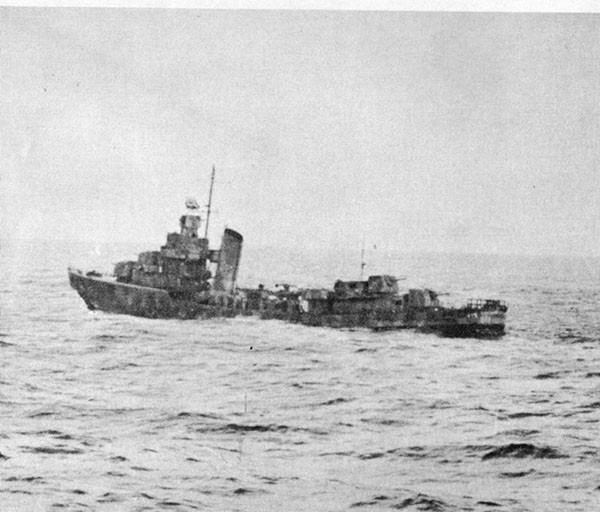
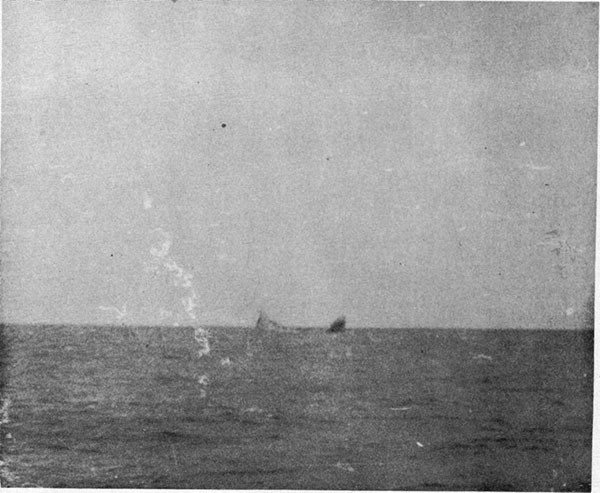
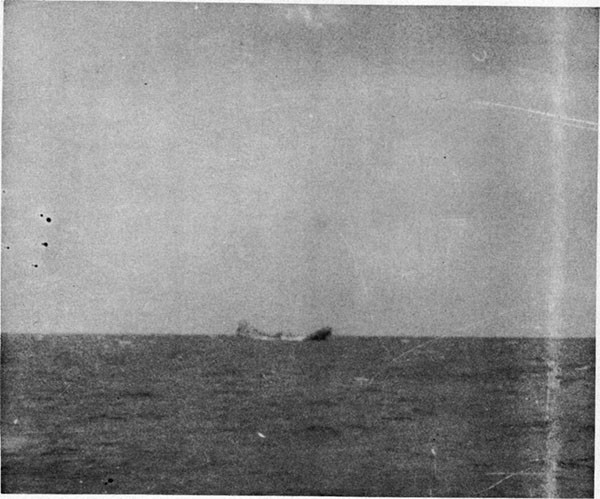
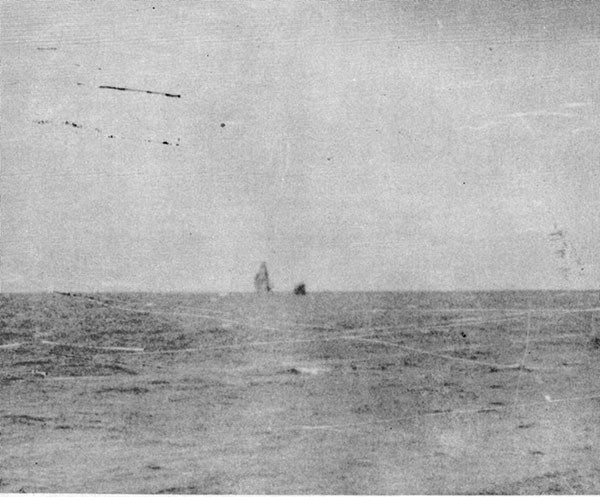
Around 8:00 AM, the end came for O'Brien.  Below are pictures of the sinking, as the bow and stern folded upwards but did not separate, and the ship sank slowly as one unit, still held together by the main deck.

Photo 6: At 0645, 19 October, 1942. Note permanent upward set of bow.
Photo 7: At 0750, 19 October, 1942. Heavy list to starboard. Breaking up process well advanced.
Photo 8: At 0755-1/2, 19 October, 1942. Bow and stern sharply inclined.
Photo 9: At 0957, 19 October, 1942. Bow and stern apparently held together by main deck, piping and wiring. By 0758 O'BRIEN had disappeared.

 Click Read More to see the full narration of the last day from Damage Report #28, pp. 6-8:

Sunday, October 16, 2022

October 16, 1942 - Friday - 80 years ago today

Status - John Skinner - USS O'Brien: 

O'Brien, with its escorts Cimmaron and Lang, reached Suva, Fiji on the 13th, and had only a broken plate as damage since being repaired at Noumea.  After repairs the ships left on the 16th toward American Samoa and then on to the West Coast.  There were two October 16ths, as the date line was crossed at midnight on the 16th and date was backed up a day.  Water leakage was increasing on O'Brien but was not yet considered serious.  War Damage Report #28 narration:

Task Group 66.3 arrived at Suva on 13 October. While there, damage and previous repairs to O'BRIEN were thoroughly inspected. Except for the broken plate on No. 6 port longitudinal no other evidence of failure or weakness in the repairs previously made was discovered. The broken plate was repaired by welding an angle to it, apparently along the top.

Departure from Suva was made about 1430 on 16 October. Shortly after departure and when in the open sea, rate of leakage again increased but not alarmingly so as one fire and bilge pump was more than adequate to control the leakage. Wind and sea were still very moderate.

At 0000, zone minus 12, October 17, the date was changed due to crossing the international date line and the 16th was repeated.

 Bombardment of Guadalcanal

The Marines were heavily bombarded for three consecutive nights, the first night Japanese battleships fired 14 inch shells into the airfield and surroundings.  Japanese heavy cruisers did more damage the second night.  The US Navy was unable to counter these attacks, and the Marines have not forgotten even to this day.  Most of the planes at the field were damaged or destroyed and the Japanese also landed several thousand more troops on the island.  This appeared to be another big Japanese offensive to push the Marines off the island.

U. S. Navy Task Forces:

  • Task Force 16 (Enterprise) sailed from Pearl Harbor on October 16th for the South Pacific.
  • Saratoga remained at Pearl Harbor for repairs (sailed November 10th).
  • Combined Task Force 61 remained on patrol in the Coral Sea near Guadalcanal.
    • Task Force 17 (Hornet) -> TF 61 

More Information:


NEXT POST: OCTOBER 20TH


Saturday, October 8, 2022

October 8, 1942 - Thursday - 80 years ago today

Status - John Skinner - USS O'Brien: 

O'Brien remained at Noumea (code name WHITE POPPY) alongside repair ship Argonne for further and more permanent repairs.  Repairs would be finished October 10th.

Hornet conducted a raid on Japanese forces in the Shortland Islands, which are further up the Solomons chain near Bougainville.  The raid was hampered by inclement weather, and so achieves little.

Japanese Navy plans include a cruiser force coming down the slot to shell Guadalcanal while other ships unloaded supplies.  US cruiser forces, now better trained and equipped, would soon have to detect and counter this force.

U. S. Navy Task Forces:

  • Task Force 16 (Enterprise) was at Pearl Harbor, for repairs to Enterprise (sailed October 16th).
  • Saratoga was at Pearl Harbor for repairs (sailed November 10th).
  • Combined Task Force 61 remained on patrol in the Coral Sea near Guadalcanal.
    • Task Force 17 (Hornet) -> TF 61 

More Information:


NEXT POST: OCTOBER 12TH


Tuesday, October 4, 2022

October 4, 1942 - Sunday - 80 years ago today

Status - John Skinner - USS O'Brien: 

O'Brien remained at Noumea (code name WHITE POPPY) alongside repair ship Argonne for further and more permanent repairs.  Repairs would be finished October 10th.

Here are some more details on the repairs, from the Navy report:

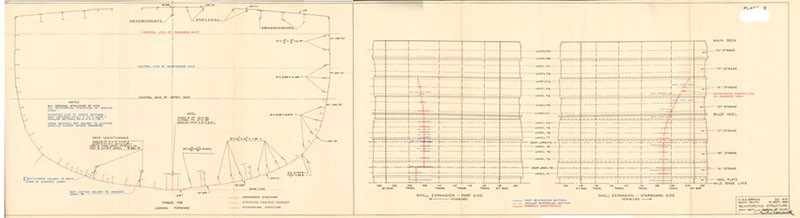
Details of hull repairs to the bottom structure, frames 103-109, in the forward engine room are shown on plate II. Attention is invited to the following features:

(a) Only partial longitudinals were installed. That is, fore-and-aft extent was only three frame spaces for all temporary members. Installation was made by welding longitudinals to the shell. Somewhat less than half of the replacement sections had the ends welded to adjacent web frames.

(b) Scantlings used were either about the same or larger than those of the longitudinals which each temporary member was to reinforce. There was no allowance, however, in the scantlings to replace the strength of the ship girder lost by the wrinkled bottom shell plating, including the flat keel.

(c) The partial longitudinals installed were offset transversely from the longitudinals they were obviously intended to reinforce. 


 Plate II

 Plate II: Reinforcing Structure.


 ----------------------------

Admiral Nimitz visited the area during this time, starting on September 28th landing at Noumea.  A meeting was held on Argonne to discuss current activities and future strategy.  Admiral Ghormley, who was in charge of the theater, was showing deeply the stresses of command.  Noumea itself was choked with cargo ships unable to unload at the relatively small port.  Nimitz went to Guadalcanal after the meeting, and then back to Hawaii.  

Hornet and escorts had moved northwest for a raid on Japanese forces in the Shortland Islands, near Bougainville Island.  These forces were a constant danger to Henderson Field and the Marines on Guadalcanal.

U. S. Navy Task Forces:

  • Task Force 16 (Enterprise) was at Pearl Harbor, for repairs to Enterprise (sailed October 16th).
  • Saratoga was at Pearl Harbor for repairs (sailed November 10th).
  • Combined Task Force 61 remained on patrol in the Coral Sea near Guadalcanal.
    • Task Force 17 (Hornet) -> TF 61 

More Information:


NEXT POST: OCTOBER 8TH


Friday, September 30, 2022

September 30, 1942 - Wednesday - 80 years ago today

Status - John Skinner - USS O'Brien: 

O'Brien remained at Noumea (code name WHITE POPPY) alongside repair ship Argonne for further and more permanent repairs.  Repairs would be finished October 10th.

There continued a tense calm around Guadalcanal.  Hornet was able to make a short visit to Noumea to resupply and refuel.

U. S. Navy Task Forces:

  • Task Force 16 (Enterprise) was at Pearl Harbor, for repairs to Enterprise (sailed October 16th).
  • Saratoga was at Pearl Harbor for repairs (sailed November 10th).
  • Combined Task Force 61 remained on patrol in the Coral Sea near Guadalcanal.
    • Task Force 17 (Hornet) -> TF 61 

More Information:


NEXT POST: OCTOBER 4TH


Tuesday, September 27, 2022

September 26, 1942 - Saturday - 80 years ago today

Status - John Skinner - USS O'Brien: 

O'Brien arrived at Noumea (code name WHITE POPPY) on the 23rd, and went alongside repair ship Argonne for further and more permanent repairs.  All work on O'Brien would be done on October 10th.  Below is described the transit to Noumea and some of the modifications done to the ship:

Upon departure from BUTTON, course was laid for WHITE POPPY, 600 miles distant, and O'BRIEN arrived on 23 September. Engine speed during the passage was for 12.5 knots but speed over the ground was only 11.5 knots. Again wind and sea never exceeded moderate intensity. O'BRIEN remained at WHITE POPPY until 10 October. During this period further repairs were accomplished by ARGONNE and ship's force.
 
During the two passages described above, O'BRIEN rode easily. Working of the forward and aft portions of the vessel with respect to each other was not observed although careful inspections and observations were frequently made. Repairs to the bottom at BUTTON by CURTISS were very effective in reducing leakage in the forward engine room. Only one fire and bilge pump was required to control leakage from BUTTON to WHITE POPPY whereas the main circulator, operating at near capacity, was required to control leakage prior to arrival at BUTTON.
 
At WHITE POPPY, ARGONNE executed further temporary structural repairs. At the stem a partial new bow section, extending down from the forecastle deck to half way to the waterline, was installed to protect against the force of seas when pitching.

U. S. Navy Task Forces:

  • Task Force 16 (Enterprise) was at Pearl Harbor, for repairs to Enterprise (sailed October 16th).
  • Saratoga was at Pearl Harbor for repairs (sailed November 10th).
  • Combined Task Force 61 remained on patrol in the Coral Sea near Guadalcanal.
    • Task Force 17 (Hornet) -> TF 61

 As only Hornet was currently available, it would fall to the cruisers and destroyers to protect the Marines on Guadalcanal to try to block Japanese forces coming down the Slot to bombard the Marines and/or to deliver troops and supplies.  Given the bad performance in the early night battles, especially Savo Island, intense drills and practice for night battles was done all through late September.

More Information:

  • Official Navy Chronology, pp. 254-256.
  •  The First Team and the Guadalcanal Campaign,  John B. Lundstrom, pp 233-243.
  • The Struggle for Guadalcanal, Samuel Eliot Morison, pp. 138-139.
  • Neptune's Inferno, The U.S. Navy at Guadalcanal, James D. Hornfischer, pp. 132-144.


NEXT POST: SEPTEMBER 30TH


Thursday, September 22, 2022

September 22, 1942 - Tuesday - 80 years ago today

Status - John Skinner - USS O'Brien: 

O'Brien had arrived on the 16th at Espiritu Santo (code name BUTTON) and remained until the 21st. Curtiss would do the temporary repairs.  Below are excerpts from War Damage Report No. 28 regarding the damage and repairs:

Photos 2 and 3 portray the small amount of local structural damage at the bow. Center of impact appears to have been just abaft the forefoot and possibly 10 feet below the waterline. The draft forward prior to damage was 11'-7". As shown on plate I, the bow structure below the main deck and aft to frame 10 was blown away. Framing and plating back to frame 14 were twisted and distorted. Free flooding occurred below the first platform between frames 10 and 22. Draft forward increased to 12'-2". A-202-L, on the first platform, flooded slowly to a depth of about two feet, the water entering through ruptures in the deck and bulkhead 14 as the bow plunged into the seas. Bulkhead 22 remained tight but was bulged aft. Bulkhead 25 was undamaged.

Photos 2 and 3:  Structural Damage at the Bow.  Quite a bit of the bow was shot away. but as noted above, the structure is holding.


Severe vertical flexural vibration of the hull occurred. Although some buckling of hull plating and longitudinals occurred in the vicinity of frames 37, 78 and 123, some of which is shown in photos 4 and 5, the most serious failures were centralized across the bottom structure in the vicinity of frame 104. Here, as will be noted on plate II, the vertical keel, No. 2 deep longitudinals, No. 6 deep longitudinals, several smaller longitudinals and bottom plating all failed to some degree. The Commanding Officer reported that wrinkling and buckling of the shell and longitudinals, including the vertical keel, extended from frame 104 on the starboard side across to frame 108 port. The entire bottom flange of the ship girder was thus seriously damaged. In addition, many rivets in this area were loosened or sheared. Considerable leakage into the forward engine room resulted through seams and rivet holes. The Commanding Officer reported that planes of the roller paths of the after 5" guns were depressed about one degree to port indicating that the after portion of the hull was twisted slightly to port.

Photos 4 and 5:  Topside damage accompanying damage to the bottom structure amidships.


Other damage is also described in the War Damage Report.  Below excerpt describes the temporary repairs done at Espiritu Santo:

O'BRIEN remained at BUTTON until 21 September. During this period O'BRIEN, CURTISS and the Seventh Naval Construction Battalion effected temporary repairs. Bulkhead 6 above the main deck, the main deck, the deck of A-202-L and bulkhead 14 between the first platform and main deck were all made tight by patching holes. Bulkheads 6 and 14 were reinforced with concrete. The deck of A-202-L and bulkhead 14 were also strongly shored. In addition, divers installed plug bolts and patches in the bottom plating of the forward engine room. All except two 600-pound depth charges were removed as were 150 rounds of 5" A.A. common. Finally, anchors and anchor chains were removed from the bow and stowed aft.

O'Brien left Espiritu Santo on the 21st en route to Noumea (code name WHITE POPPY), which is about 460 miles SSE from Espiritu Santo.


U. S. Navy Task Forces:

  • Task Force 16 (Enterprise) was at Pearl Harbor, for repairs to Enterprise.
  • Saratoga was at Pearl Harbor for repairs.
  • Combined Task Force 61 remained on patrol in the Coral Sea near Guadalcanal.
    • Task Force 17 (Hornet) -> TF 61

More Information:

  • Official Navy Chronology, pp. 253-254.
  •  The First Team and the Guadalcanal Campaign,  John B. Lundstrom, pp 229-232.
  • The Struggle for Guadalcanal, Samuel Eliot Morison, pp. 130-138.
  • Neptune's Inferno, The U.S. Navy at Guadalcanal, James D. Hornfischer, pp. 118-131.


NEXT POST: SEPTEMBER 26TH


Sunday, September 18, 2022

September 18, 1942 - Friday - 80 years ago today

Status - John Skinner - USS O'Brien: 

Hornet and Wasp were now protecting the convoy that was to bring the new Marine regiment to Guadalcanal.  The two carriers were separated by about 5 miles, and were in the Coral Sea, about 150 miles southeast of San Cristobal Island, which was at the southeast end of the Solomons chain.  They were maintaining a position between Japanese forces and the convoy, and had planes in the air constantly.  Wasp had the day's duty for the combat air and anti-submarine patrols.

Several spots in the oceans had been nicknamed "Torpedo Junction" (no doubt sardonically named after the Glenn Miller Orchestra's Tuxedo Junction, a #1 hit song in 1940).  The two carriers were right in the middle of one of these.  Japanese submarines were always present here, and with the convoy in the area, were even more alert.  

Wasp was maneuvering to recover planes, and inadvertently lined itself up for a shot from Japanese submarine I-19.  The Japanese sub took full advantage, firing a spread of 6 torpedoes at the carrier.  Three impacted Wasp and started a series of huge explosion on the carrier.  Sailors on  the O'Brien would have seen the explosions immediately, but would have already begun to change their ship's course in reaction before they heard the report of the blasts some half a minute later.

The three torpedoes that missed Wasp continued on with their remaining fuel.  One of these was dodged by destroyer Mustin but scored a direct hit on battleship North Carolina.  The other two were heading straight for the USS O'Brien.

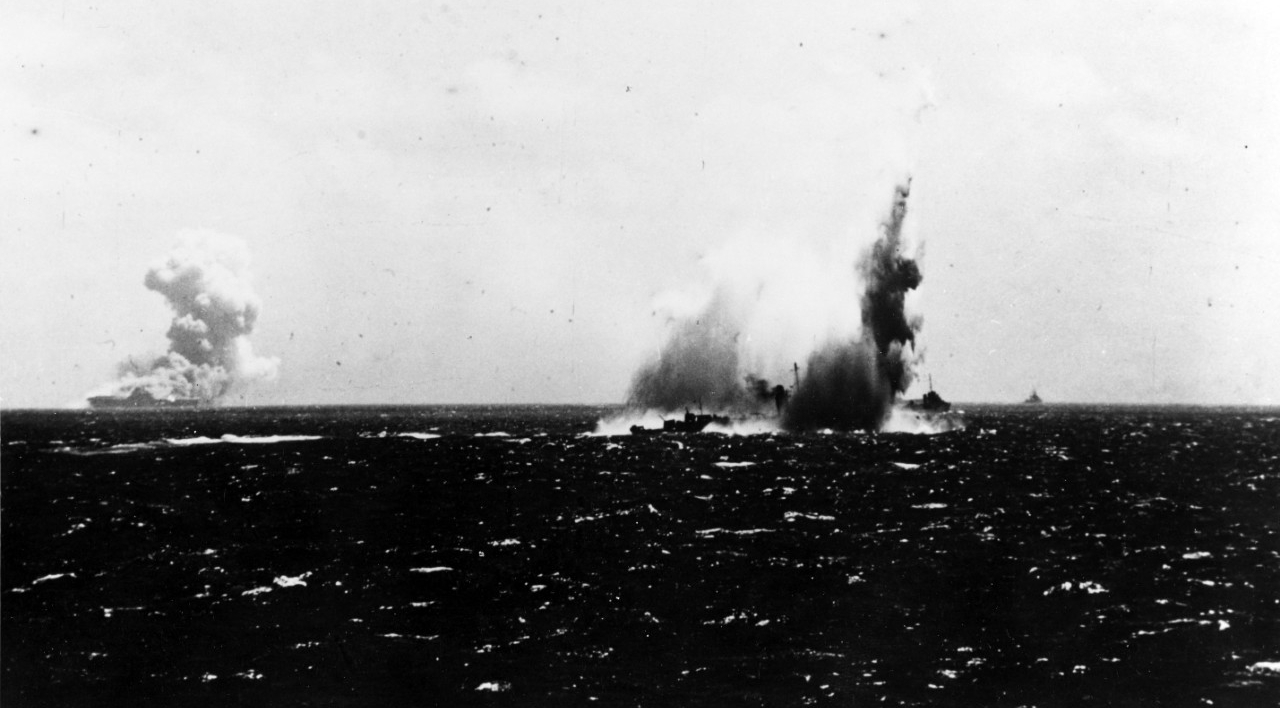
 O'Brien's crew had seen the first torpedo, and had swerved to starboard, successfully avoiding the it as it passed a small distance from the stern.  The second torpedo, however, had gone unnoticed; by the time it was seen it was to late to avoid, and crashed into O'Brien's bow.  The moment of impact was captured in one of the more famous photos of World War 2 (below):

Wasp burns in the background as torpedo strikes O'Brien:

Photo #: 80-G-457818  USS O'Brien (DD-415)


The torpedo had severely damaged the bow on the O'Brien and shaken the ship violently, but there were no casualties.  Even with the damage, the ship could still make 15 knots, and was ordered to head unescorted to Espiritu Santo (BUTTON) for repairs, reaching there on the 16th.  O'Brien went alongside repair ship USS Curtis.

Wasp continued to burn and could not be salvaged.  It was sunk with torpedoes from destroyer Lansdowne. Hornet took on Wasp's planes that were still airborne, and was now the only US carrier in the South Pacific.  The Wasp's sinking was held secret until December; only then could sailors on leave talk about the loss of Wasp.

North Carolina returned to Pearl Harbor for repairs.  Fast Battleship strength was down from three to one as a result (South Dakota having earlier scraped a reef and retired to Pearl Harbor).

This single spread of torpedoes was the most devastating of the war; it had initially been credited to two Japanese submarines, but in reality came only from I-19.

The convoy carrying the Marines, despite losing much of its air cover, did land on Guadalcanal on the 18th, bringing much needed relief to the garrison there.

In 2019 a search was conducted for the sunken Wasp - Article:

U. S. Navy Task Forces:

  • Task Force 16 (Enterprise) was at Pearl Harbor, for repairs to Enterprise.
  • Saratoga was also returning to Pearl Harbor for repairs.  Arrives Sep. 21.
  • Combined Task Force 61 remained on patrol in the Coral Sea near Guadalcanal.
    • Task Force 17 (Hornet) -> TF 61
    • Wasp was sunk by Japanese submarine I-19 on September 15th.

More Information:

  • Official Navy Chronology, pp. 252-253.
  •  The First Team and the Guadalcanal Campaign,  John B. Lundstrom, pp 221-229.
  • The Struggle for Guadalcanal, Samuel Eliot Morison, pp. 130-138.
  • Neptune's Inferno, The U.S. Navy at Guadalcanal, James D. Hornfischer, pp. 118-131.


NEXT POST: SEPTEMBER 22ND